Research Ugandan law, with every source cited.
Ask PractoCore a research question in ordinary language. It searches the Laws of Uganda and its collection of decided cases, and answers with the Act and section or the judgment it relied on, so you can open the source and read it. For a longer question, Deep Research plans a fuller search for your approval and returns a cited memo.
Research still means a row of open tabs.
Finding the limitation period for a land claim can mean the Act on one tab, ULII on another, two judgments and last year’s memo, with the findings copied into a draft by hand. General chatbots answer faster, but they draw on English and American law as readily as Ugandan law, and an answer that does not show its source cannot go into a submission.
What it searches, and what you see.
The Laws of Uganda, in full
All 351 Acts of the Principal Laws of Uganda, 7th Revised Edition, across the 14 Red Volumes, and the Constitution, held as full text. An answer quotes the section it relied on and links to it.
Decided cases, a growing collection
Supreme Court judgments are held in full, High Court judgments substantially and Court of Appeal judgments in part. Constitutional Court judgments are not yet held. A citation opens the judgment at the paragraph relied on.
Your firm’s own documents
Put the same question to the vault and it answers from the pleadings, opinions and precedents your firm already holds, with the page each answer came from.
Deep Research for the longer question
BetaFor a novel point or a memo across several authorities, it proposes a research plan. Once you approve it, it works through the Laws of Uganda, the case-law collection and your vaults, and returns a memo with each source cited.
From research to a draft
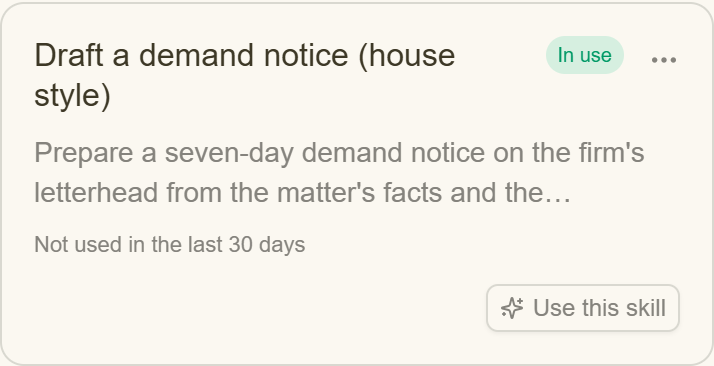
Turn what you found into an editable Word document, such as a memo or written submissions, in your firm’s house style and Ugandan court formatting.
It says when it has nothing
Answers come from what it retrieved. Where the collection holds nothing on point, it is built to say so instead of producing a plausible citation.
How a research question runs.
- 01
Ask in your own words
Type or dictate the question as you would put it to a colleague, from a matter or on its own.
- 02
Watch the search
You see each step as it runs: the Acts and judgments it searched and the provisions it opened.
- 03
Read the sources
Every section and judgment in the answer is a link. Open it and read the text the answer relied on.
- 04
Use what holds up
Keep the answer, take it into a draft, or ask a follow-up. What goes into your work is your decision.
The research is checkable, and the opinion is yours.
Sources you can open
PractoCore does not give legal opinions. It finds the provisions and judgments that bear on your question and shows them, and the conclusion you draw stays with you.
Ugandan sources
Its legal sources are Ugandan legislation and Ugandan judgments, held and indexed by PractoCore, alongside your firm’s own documents.
Coverage stated plainly
The coverage page sets out, court by court and with a date, what the collection holds and what it does not, including that statute holdings run to 31 December 2023.
“Is this legal advice?”
No. PractoCore finds and cites the law and the judgments that bear on a question. Reading them and forming the opinion is the advocate’s work, and every source is shown so that it can be checked.
“How complete is the case law?”
The Supreme Court is complete, the High Court substantially complete and the Court of Appeal partial and expanding. The Constitutional Court is not yet held. The coverage page gives the position court by court with the date it was last checked.
“How current is the legislation?”
Statutes follow the Principal Laws of Uganda, 7th Revised Edition, revised to 31 December 2023, and the Constitution as amended. An Act passed or amended after that date may not be held, so check currency on anything recent.
“How is it different from ULII?”
ULII is a free library of Ugandan legislation and judgments that you search and read yourself. PractoCore takes a question in ordinary language, searches its own collection of Ugandan legislation and judgments, and answers with the sources cited, next to your firm’s matters and documents.
“How is it different from ChatGPT?”
A general chatbot answers from what it learned in training and from what you paste in, and it does not reliably separate Ugandan authority from foreign authority. PractoCore searches Ugandan legislation and judgments for each question and cites the section or case it relied on.
“How can we test it before buying?”
Use the benchmark page. It sets out a ten-question test: bring questions you already know the answers to, five on statute and five on decided authority, and check each answer and its sources.
“What does it cost?”
Pricing is quoted for each firm. It is per seat in Ugandan Shillings, billed monthly or annually and payable by mobile money, with no seat minimum and no multi-year commitment. Every firm starts with 30 days free, with every feature and no card. Ask us for a quote and we will put it in writing.
Works with the rest of PractoCore.



Bring a question you have already answered.
Start the 30-day trial, ask it something you know the answer to, and check every source it cites.
Free for 30 days · No card required · Built for Ugandan practice.